
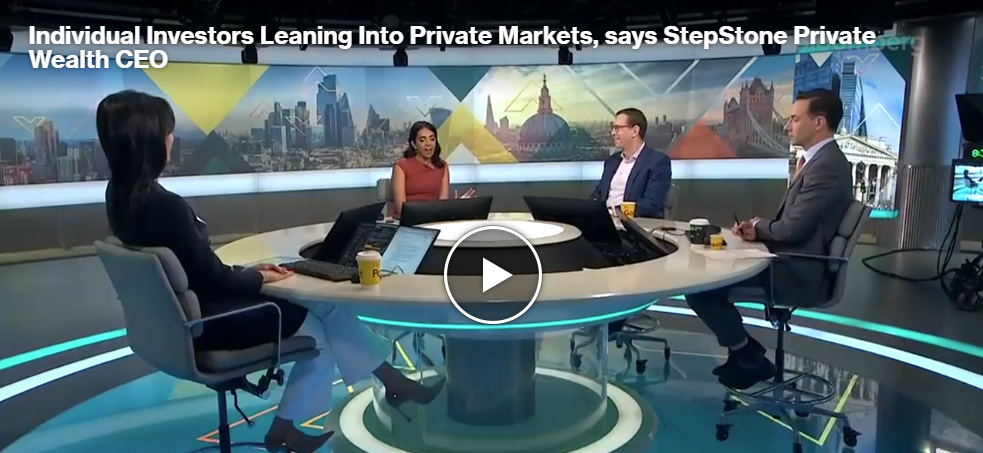
- The concept of private market discounts and how it impacts returns
- The emergence of infrastructure as a private market asset class, including its definition and role in potential inflation protection
- How StepStone identifies and accesses differentiated opportunities in high-growth sectors
Performance data quoted represents past performance and is no guarantee of future results.
Before investing you should carefully consider the Fund’s investment objectives, risks, charges and expenses. This and other information is in the StepStone Private Markets Fund “SPRIM” prospectus, StepStone Private Venture and Growth Fund “SPRING” prospectus and StepStone Private Infrastructure Fund “STRUCTURE” prospectus, a copy of which may be obtained from StepStone Private Wealth at 704.215.4300 or by visiting stepstonepw.com. An investor should read the prospectus carefully before investing.
The statements and opinions expressed are those of the presenter(s). Any discussion of investments and investment strategies represents the presenter’s views as of the date created and are subject to change without notice. Information presented is for general purposes only and is not intended to provide specific advice or recommendations for any individual.
Fund holdings and allocations are subject to change and are not recommendations to buy or sell any security. For a complete list of portfolio holdings, please visit the SPRIM, SPRING and STRUCTURE product pages on our website. Holdings in infrastructure assets do not guarantee downside protection of an investment in the funds and a complete loss of investor’s principal is possible. There is no guarantee that a particular investment strategy will be successful.
Investment objectives will vary greatly among all structures and directly impact the volatility of any given fund, however private market funds are generally expected to be more speculative than registered funds due to the differences in regulatory oversight requirements. While mutual funds are limited in the amount of illiquid and derivative investments they may make, closed-end funds have less limitations, and private funds generally have no restrictions on such holdings. The performance of private market funds is difficult to measure and therefore such measurements may not be as reliable as performance information for other investment products. In addition to the transactional fees and ongoing operating expenses contained within most fund structures, many private market funds often include an additional performance fee applicable to investors.
Registration with the SEC does not guarantee the success of an investment nor provide insurance of any assets.
An investment in the Funds involve risks. The Funds should be considered speculative investments that entail substantial risks, and a prospective investor should invest in the Funds only if it can sustain a complete loss of its investment. Fund fees and expenses may offset trading profits. Fund shares are illiquid and appropriate only as a long-term investment. There is no secondary market for the Funds’ Shares and the Funds expect that no secondary market will develop in the foreseeable future. The risks of investing in venture capital and growth equity companies are generally greater than the risks of investing in public companies that may be at a later stage of development. Secondary investments may be acquired by the Funds as a member of a purchasing syndicate, and they may be exposed to additional risks such as (i) counterparty risk, (ii) reputation risk, (iii) breach of confidentiality by a syndicate member, and (iv) execution risk. Infrastructure companies may be subject to a variety of factors that may adversely affect their business, including economic slowdown, supply and demand volatility, increased competition, fluctuations in usage, expenses, and revenue, lack of fuel availability, energy conservation policies, technological obsolescence and changes in interest rates, regulations, or fiscal and monetary policy. Property values may fall due to increasing vacancies or declining rents resulting from unanticipated economic, legal, cultural or technological developments. There is no regular market for interest in infrastructure assets, which typically must be sold in privately negotiated transactions that can occur at a discount to the stated NAV.
Secondary investment acquisition negotiations may rely on incomplete or imperfect information, resulting in the risk that the Fund may pay a higher price that it would have otherwise given more comprehensive facts which could negatively impact performance. When the Fund acquires a secondary investment fund, it is typically not empowered to make modifications or amendments to the constituent documents and does not usually have the authority to negotiate the underlying economic terms of the interests it is acquiring.
Investments may consist of loans to small and/or less well-established privately held companies that have reduced access to the capital markets, resulting in diminished capital resources and the ability to withstand financial distress. Non-diversified Funds may concentrate their assets in fewer individual holdings than a diversified fund. Though valuations of Fund investments are ordinarily made quarterly, some of the Funds will provide valuations, and will issue shares, on a more frequent basis. Fund investments will be fair valued and are subject to adjustment. Fund acquisitions may be negotiated based on incomplete or imperfect information which could impact performance. The Funds may maintain a sizeable cash position in anticipation of funding capital calls. Holding a portion of the investment portfolio in cash or cash equivalents may have a negative effect on overall performance. The Fund’s “over-commitment” strategy could result in an insufficient cash supply to fund unfunded commitments to investment funds resulting in negative impacts to the Fund. Please see the prospectuses for details of these and other risks.
The SPRIM, SPRING and STRUCTURE funds are distributed by Distribution Services, LLC which is not affiliated with StepStone Group Private Wealth, LLC or any of the other products and individuals.
STRUCTURE was formed in 2023 and has limited performance history that Shareholders can use to evaluate the Fund.